
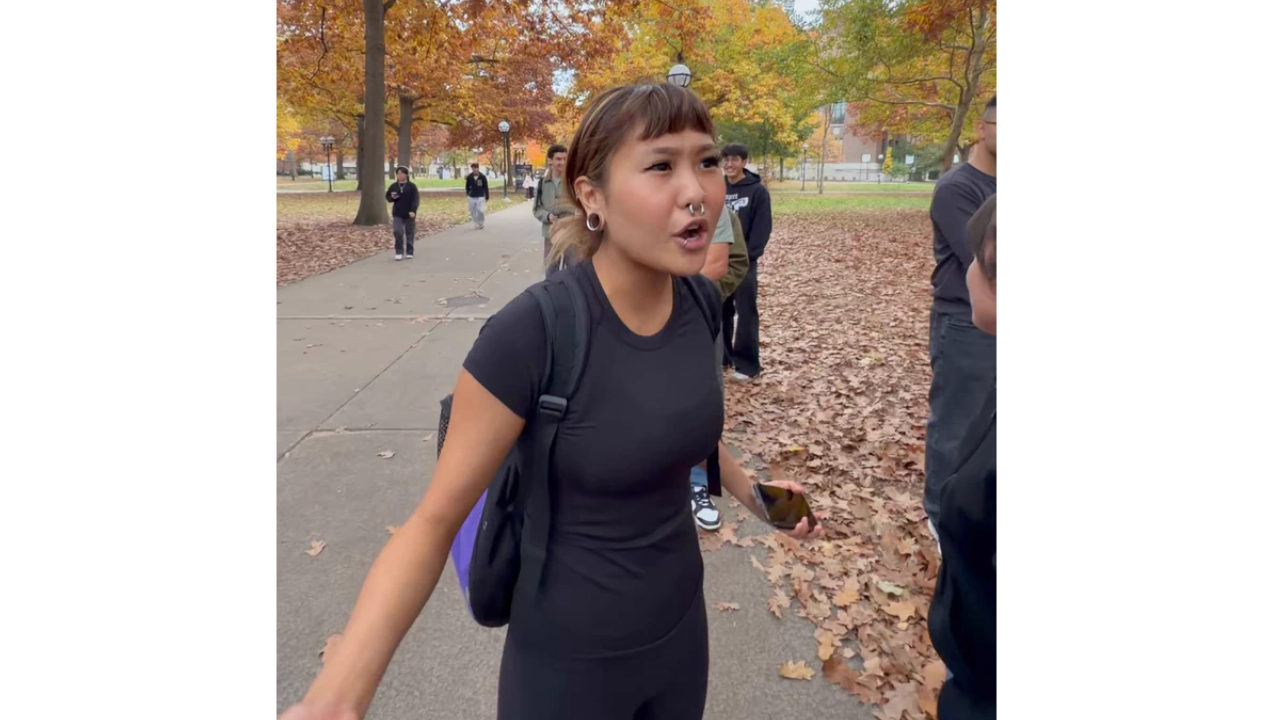
Temulun Togochog, an 18-year-old reportedly attending the University of Michigan, was identified in online reports following an arrest during a confrontation with conservative Jewish content creator Liz Benichou on November 1, 2026. The incident occurred near a political demonstration on the Ann Arbor campus and quickly attracted attention after videos appeared to show a physical altercation, police intervention and threatening remarks. University police confirmed an arrest involving a student, although formal criminal charges had not been announced in the initial reports.
What Happened?
The confrontation took place on Sunday, November 1, near a campus event associated with the Liberty Under Fire USA tour.
The event featured political and religious commentary, including displays questioning the compatibility of Islam with Western values.
Liz Benichou, a social media personality known online as @basedinmalibu, was participating in discussions near the demonstration when an argument developed with a young woman.
According to circulating footage and subsequent reports, the exchange became increasingly confrontational before turning physical.
University police officers intervened and detained the student.
The incident later became the subject of widespread discussion about campus speech, political disagreements and physical safety.
Who Is Temulun Togochog?
Temulun Togochog has been identified in social media discussions and news coverage as an 18-year-old University of Michigan student.
Her name circulated after videos of the November 1 confrontation gained attention online.
However, the university police statement described in initial reports confirmed the arrest of a student without independently establishing every personal detail attributed to Togochog.
Publicly verified information about her academic program, background and university activities remains limited.
Claims about her political affiliations have also circulated, but participation in a campus confrontation does not establish membership in a political campaign or organization.
Her identity and any alleged involvement must be considered alongside official records as they become available.
Argument Before Arrest
The dispute reportedly began during a discussion about religion, women’s clothing and social expectations.
According to published accounts, Benichou questioned how the student might be treated in Iran if she appeared publicly wearing revealing clothing.
The remark reportedly intensified an already heated exchange.
Video footage circulating online appears to show the student moving toward Benichou before physical contact occurred.
Reports describe Benichou being pushed to the ground.
The available accounts identify the alleged shove as the immediate reason for police intervention, although a complete official reconstruction has not been released.
The broader conversation preceding the altercation has not been independently established in full.
Police Intervention
Officers from the University of Michigan Division of Public Safety and Security (DPSS) responded to the confrontation.
According to the initial police information described in reports, officers witnessed an incident involving a student and an individual not affiliated with the university.
The student was taken into custody following the physical encounter.
Videos shared on social media appear to show officers restraining and handcuffing a young woman before escorting her away.
The police response prevented the confrontation from continuing.
The arrest itself does not establish criminal guilt, and any formal allegations must be evaluated through the legal process.
Alleged Threats
One of the most widely discussed elements of the incident involved statements reportedly made while the student was being detained.
Circulating recordings appear to capture a threatening remark directed toward Benichou.
The statement has been reported as: “I should’ve killed you when I had the chance.”
The alleged remark prompted strong reactions among viewers because of its threatening language.
However, the exact wording, surrounding context and potential legal significance require assessment through authenticated evidence.
It has not been established from the available information whether prosecutors will pursue a separate allegation related to the statement.
Police and prosecutors must determine which reported actions, if any, support criminal charges.
Who Is Liz Benichou?
Liz Benichou is a conservative Jewish social media commentator who uses the online name @basedinmalibu.
Her content frequently involves political discussions, public interviews and commentary about religion and contemporary social issues.
She has attracted attention through confrontational conversations with people holding opposing views.
The Ann Arbor incident brought her wider visibility after videos of the altercation circulated across multiple platforms.
Following the confrontation, Benichou reportedly stated that she was safe and had not suffered severe injuries.
She also expressed an intention to pursue legal action.
Her reported desire to press charges does not independently determine whether prosecutors will authorize a criminal case.
Was She Released?
According to initial reports, the arrested student was processed and subsequently released pending warrant authorization.
This means the matter was referred for further legal review rather than immediately resulting in publicly confirmed formal charges.
In Michigan, prosecutors generally review investigative materials before deciding whether to authorize criminal charges.
The available information does not establish that Togochog has been convicted, formally charged or found responsible for a criminal offense.
Release following an arrest also does not necessarily mean an investigation has ended.
Further action depends on the evidence and decisions made by the appropriate authorities.
Political Claims
Some online posts described the arrested woman as a possible supporter of Michigan Democratic Senate candidate Abdul El-Sayed.
However, no independently verified evidence in the supplied reports establishes that she represented his campaign or acted on its behalf.
Personal political opinions, campaign affiliations and organizational involvement are separate matters that require reliable evidence.
The confrontation occurred during a period of heightened political debate in Michigan, which contributed to its rapid circulation online.
Nevertheless, the alleged physical incident should be evaluated on its own facts rather than through unsupported assumptions about political connections.
Campus Reaction
The incident has renewed questions about the boundaries between protected expression and unlawful conduct on university campuses.
Public universities regularly host demonstrations involving controversial political and religious subjects.
Participants generally have the right to express opposing opinions, including views that others may consider offensive.
However, free speech protections do not automatically extend to physical assault or legally actionable threats.
University officials and law enforcement must balance public safety with constitutional rights.
The Ann Arbor confrontation illustrates how quickly an argument can escalate when emotionally charged subjects are discussed in public spaces.
Latest Update
As of November 3, 2026, initial reports indicate that a University of Michigan student was arrested following the November 1 confrontation involving Liz Benichou.
Temulun Togochog has been publicly identified in reports about the incident, but the available police information does not independently confirm every detail circulating about her.
The student was reportedly released pending warrant authorization, with no confirmed prosecutorial charging decision established in the information available.
Benichou has indicated that she intends to pursue the matter legally.
The next significant development would be an official announcement from prosecutors or university authorities concerning any charges, disciplinary measures or investigative findings.
Until then, the arrest should be distinguished from a criminal conviction, and unverified social media allegations should not be presented as established facts.