
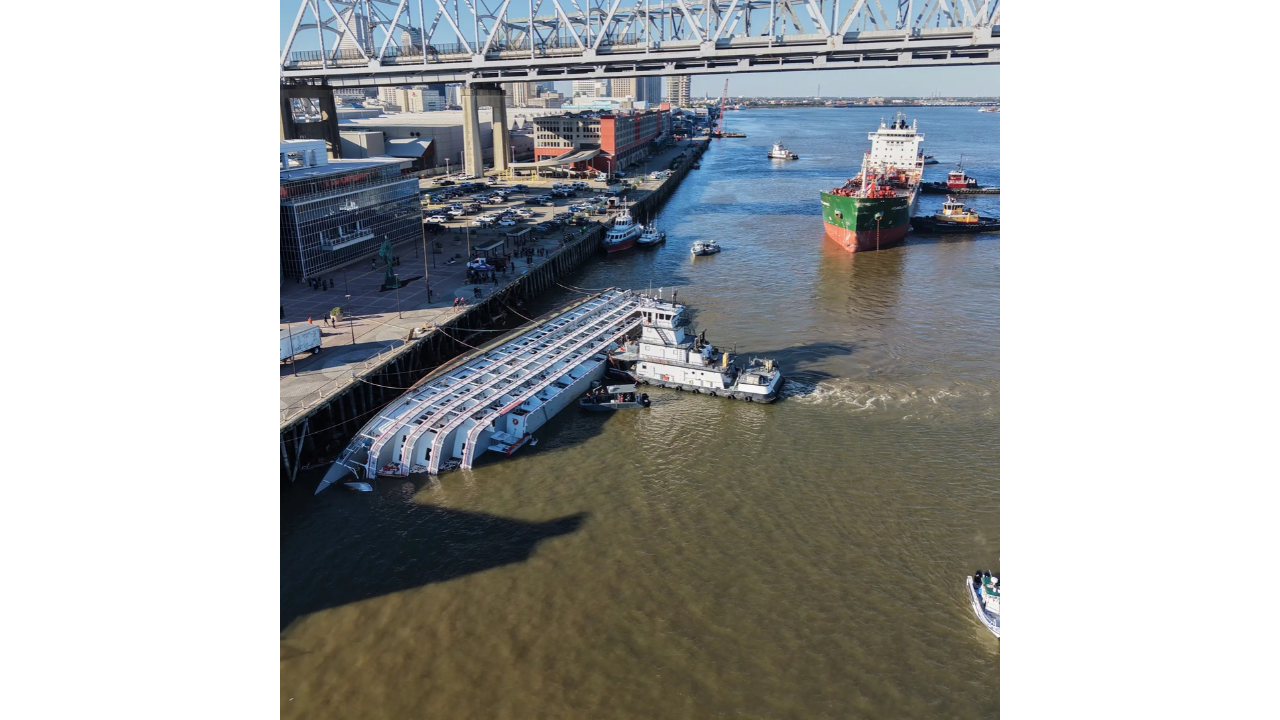
A major river cruise accident in New Orleans on November 13, 2026, left the American Heritage cruise ship partially submerged after a cargo tanker struck the vessel near the Port of New Orleans. All 180 passengers and crew members reportedly survived the collision, while 32 people were taken to hospitals with injuries described as non-critical. Emergency responders launched a large-scale rescue operation along the Mississippi River, helping passengers escape as the cruise ship began taking on water.
What Happened?
The accident occurred at approximately 12:30 p.m. local time on Friday, November 13, 2026, when the cargo tanker Atlantic Asphalt collided with the American Heritage river cruise ship.
The passenger vessel was docked near the Port of New Orleans after completing an eight-day Mississippi River cruise.
According to initial accounts, the American Heritage had arrived at its destination roughly two hours before the collision.
The approaching tanker, measuring approximately 160 meters in length, struck the cruise vessel with enough force to cause extensive damage.
Water began entering the American Heritage shortly after impact, creating an emergency for passengers and crew still aboard.
The situation quickly escalated as the vessel started leaning toward one side.
Cruise Ship Capsizes
The American Heritage began taking on water after the tanker collision and eventually rolled onto its side, becoming partially submerged in the Mississippi River.
The accident was particularly dangerous because the cruise ship was positioned alongside a busy commercial waterway used by large cargo vessels.
As the damaged passenger ship listed, crew members and emergency responders worked to move everyone to safety.
The vessel’s position near the dock helped rescuers reach passengers without requiring every person to enter the river.
However, the increasing tilt and rising water created serious concerns about the stability of the ship.
The damage left the American Heritage unable to continue normal operations, and recovery crews subsequently began assessing how to remove the vessel.
All 180 Survive
Officials reported that all 180 passengers and crew members aboard the American Heritage survived the accident.
Despite the severity of the collision and the ship’s partial submersion, no fatalities were reported in the initial rescue updates.
Emergency personnel conducted an extensive search and accountability operation to ensure nobody remained trapped or missing.
The rescue effort involved removing people from the damaged ship, assisting those who had entered the water, and providing immediate medical attention.
The outcome prompted descriptions of the incident as a “miracle on the Mississippi.”
The survival of everyone aboard was especially significant given the size of the tanker and the extensive damage sustained by the passenger vessel.
Passenger Injuries
A total of 32 people were reportedly hospitalized following the New Orleans river cruise accident.
Authorities described the injuries as non-critical, although individual medical conditions were not publicly detailed.
Some passengers required treatment after the sudden impact and evacuation.
By Saturday, November 14, reports indicated that only eight passengers remained hospitalized, suggesting that many of those initially admitted had been discharged.
Officials did not immediately release a complete breakdown of injuries among passengers and crew.
The medical response formed an important part of the emergency operation, with rescue teams coordinating transportation and treatment following the collision.
Captain’s Response
American Heritage captain Leonard Stewart reportedly remained on the bridge during the emergency to request assistance and help keep the damaged vessel alongside the dock.
His actions were especially important as the ship began losing stability.
Keeping the vessel close to the dock provided emergency responders with a more accessible evacuation route.
The captain’s reported response became one of the notable details to emerge from accounts of the accident.
However, investigators will need to examine the complete sequence of events before making any formal conclusions about the crew’s actions and the collision.
Emergency Rescue
The rescue operation involved several agencies working together along the Mississippi River.
Port NOLA Harbor Police, the New Orleans Fire Department, the U.S. Coast Guard, and nearby tugboat operators responded to the emergency.
Rescuers helped passengers leave the listing cruise ship while other teams searched the surrounding water.
Nearby tugboat crews also provided assistance during the evacuation.
The response required coordination between maritime authorities and local emergency services because of the vessel’s condition and the number of people involved.
By the end of the initial operation, officials had accounted for everyone believed to have been aboard.
What Caused the Crash?
The exact cause of the collision remains under investigation.
Initial statements suggested that the Atlantic Asphalt may have experienced a steering or propulsion problem before striking the docked cruise ship.
U.S. Coast Guard Captain Melanie Burnham indicated that investigators were examining the possibility of a loss of steering control or engine power.
The tanker was reportedly operating under the direction of a river pilot at the time.
However, an equipment malfunction has not been established as the final cause.
Investigators must determine whether mechanical problems, navigation decisions, environmental conditions, or a combination of factors contributed to the accident.
The National Transportation Safety Board launched an investigation alongside the U.S. Coast Guard.
Investigation Begins
The NTSB and U.S. Coast Guard are examining the circumstances surrounding the November 13 collision.
Investigators are expected to review vessel movements, navigation records, equipment performance, and communications before the impact.
The tanker crew’s actions and the operational condition of the Atlantic Asphalt are also likely to receive attention.
Reports indicated that a nationwide FAA ground stop initially delayed the arrival of some investigators in New Orleans.
Authorities have not announced a final determination of responsibility.
A complete investigation may take considerably longer than the initial emergency response and vessel recovery.
Ship Recovery
The Atlantic Asphalt was reportedly towed away from the accident scene after the collision.
However, removing the damaged American Heritage presents a more complicated challenge.
Officials estimated that recovering the partially submerged cruise ship could take several weeks.
Salvage teams must consider the vessel’s structural condition, its position in the river, and the safety of surrounding maritime traffic.
Recovery operations may involve specialized lifting equipment, stabilization procedures, and measures to prevent further damage.
The ship’s removal will also need to account for navigation and environmental safety along the Mississippi River.
Latest Update
As of November 15, 2026, all 180 people aboard the American Heritage were reported to have survived the New Orleans river cruise accident. Thirty-two people were hospitalized initially, with eight reportedly remaining in hospital on November 14.
The Atlantic Asphalt has been moved away from the scene, while recovery of the damaged cruise vessel is expected to take longer.
The NTSB and U.S. Coast Guard investigations remain ongoing, and the official cause of the tanker collision has not yet been determined.
The accident has raised important questions about vessel control, navigation safety, and emergency preparedness on one of America’s busiest commercial waterways.