
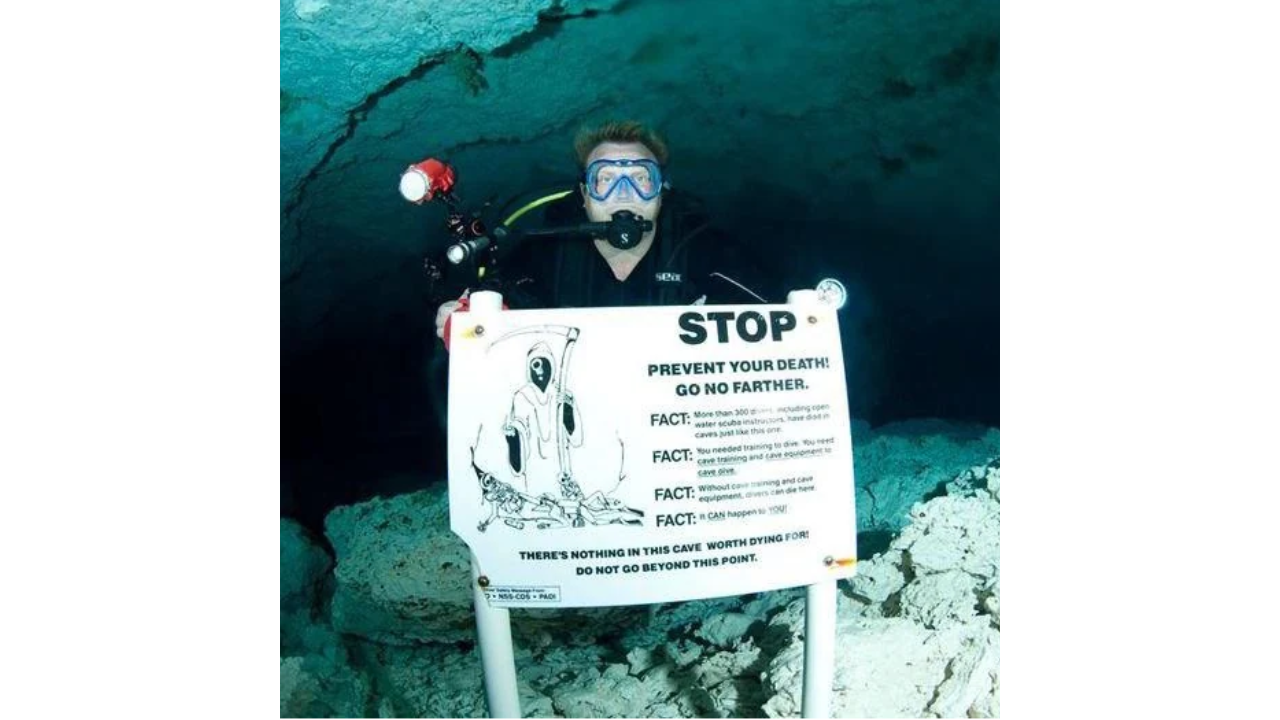
Jacob’s Well, a natural spring in Wimberley, Texas, has a disturbing history of fatal diving accidents, with historical accounts reporting at least eight deaths inside its underwater cave system. Located in Hays County, the spring attracts attention for its deep limestone passages, narrow underwater tunnels, and dangerous conditions that have trapped experienced divers. Although the water appears calm from the surface, the cave system extends more than 140 feet underground and contains passages where even a small mistake can become fatal.
What Is Jacob’s Well?
Jacob’s Well is a natural artesian spring located within Jacob’s Well Natural Area in Wimberley, Texas. It forms part of the region’s extensive underground limestone aquifer system.
The spring opens into a nearly vertical underwater shaft that leads to a complicated network of submerged chambers.
For decades, swimmers and divers have been fascinated by its clear water and unusual geological structure. However, the same underwater formations that make the location remarkable also create serious hazards.
The cave system contains narrow openings, unstable sediment, and passages that can become difficult to navigate without specialized training and equipment.
Recreational scuba diving inside the underwater caves is prohibited, with authorized scientific exploration subject to strict controls.
How Many Divers Died?
Historical accounts commonly report at least eight diving fatalities at Jacob’s Well, although some secondary sources cite figures as high as 12.
The differences arise partly because historical accident records are incomplete and some accounts combine confirmed fatalities with other reported incidents.
Several deaths occurred during attempts to explore deeper chambers, where visibility, navigation, and access become increasingly challenging.
The most dangerous sections are located beyond the initial vertical opening, where divers must travel through restricted passages without direct access to the surface.
Unlike ordinary open-water diving, cave diving requires divers to follow a safe return route through submerged tunnels.
The 1979 Tragedy
One of the most widely documented Jacob’s Well diving accidents occurred in 1979, when Kent Maupin and Mark Brashier, two young divers from Pasadena, Texas, entered the underwater cave system.
The pair reportedly traveled into the deeper chambers and failed to return.
Their disappearance triggered recovery efforts, but the difficult underwater conditions prevented rescuers from immediately retrieving their remains.
Historical accounts indicate that one diver’s remains emerged from the cave system in 1981, while the other remained trapped until a specialized recovery operation in 2000.
The 1979 deaths became one of the defining tragedies associated with Jacob’s Well, demonstrating how difficult rescue and recovery operations can become inside confined underwater passages.
Don Dibble’s Rescue
Following the disappearance of Maupin and Brashier, experienced diver and dive shop owner Don Dibble participated in efforts to recover the missing men.
During one attempted recovery in 1979, Dibble reportedly became trapped when loose gravel shifted inside a narrow underwater passage.
The situation left him struggling to escape while his available air supply became increasingly critical.
He eventually reached the surface, but the emergency ascent caused a serious pressure-related injury, described in historical accounts as a stomach rupture.
Dibble survived the incident, but his experience illustrated the extraordinary danger facing even skilled divers attempting recovery missions inside the cave.
Richard Patton’s Death
Another fatal incident occurred in 1983, involving 22-year-old Richard Patton.
According to historical accounts, Patton and another diver entered the cave without maintaining a continuous safety guideline.
While navigating a restricted section, Patton’s diving equipment reportedly became wedged inside the passage.
The divers encountered further difficulty while attempting to escape and reportedly shared an air supply.
During their effort to find a way out, they entered an underwater shaft that did not lead to the surface.
Patton drowned inside the cave, while his companion managed to escape.
The incident highlighted the dangers of losing orientation in an overhead environment where surfacing directly is impossible.
Diego Adame’s Escape
Not every serious incident at Jacob’s Well has ended in death.
In 2015, 21-year-old Diego Adame narrowly survived a dangerous freediving incident after descending approximately 90 feet into the spring without scuba equipment.
During the dive, Adame reportedly lost a flipper and his flashlight, leaving him in an extremely dangerous situation.
He managed to release his weight belt, reducing the weight pulling him downward and helping him return toward the surface.
His escape attracted attention because he survived without the breathing equipment normally required for extended underwater exploration.
The incident demonstrated that the spring’s hazards are not limited to scuba divers entering the deepest cave passages.
Why Is It Dangerous?
Several geological features make Jacob’s Well particularly hazardous.
Narrow tunnels: The cave system includes extremely restricted passages, some reportedly narrowing to approximately 15 inches.
Unstable gravel: Loose rocks and sediment can shift unexpectedly, potentially blocking routes or trapping equipment.
Poor visibility: Disturbed silt can rapidly cloud the water, making it difficult to identify the correct exit.
Confusing passages: Branching tunnels and dead-end shafts can cause divers to lose their orientation.
Limited air: Divers inside submerged caves cannot simply swim vertically to the surface when an emergency occurs.
These conditions can become especially dangerous when combined with inadequate equipment, insufficient training, or poor navigation.
The False Chimney
One particularly dangerous feature described in accounts of Jacob’s Well is the False Chimney, an underwater passage that slopes upward but does not provide an exit.
A diver who mistakes this passage for a route toward the surface can become trapped in a dead-end section.
The danger increases when visibility deteriorates or breathing gas becomes limited.
In such circumstances, returning through the original passage may be difficult without a continuous guideline and accurate knowledge of the cave.
The False Chimney has become an important example of why underwater cave navigation differs fundamentally from recreational diving.
Diving Restrictions
Authorities have introduced restrictions intended to prevent unauthorized exploration of the dangerous underwater chambers.
Historical accounts describe metal barriers installed inside the cave system to discourage divers from entering restricted passages.
Some earlier barriers were reportedly damaged or removed by unauthorized visitors.
Today, recreational scuba diving inside Jacob’s Well is prohibited, while specialized research activity requires official authorization.
The restrictions are intended to reduce the likelihood of further fatalities and prevent dangerous rescue operations.
Can Visitors Swim?
Jacob’s Well Natural Area remains a recognized natural attraction in Hays County, although swimming access depends on environmental conditions and county regulations.
Low spring flow, drought, and water quality concerns can affect whether swimming is permitted.
Visitors should not assume that the spring is open for swimming simply because the surrounding natural area is accessible.
Swimming at the surface and entering the underwater cave system are entirely different activities, with separate risks and restrictions.
Current access information should be confirmed through Hays County before planning a visit.
Latest Safety Status
As of November 2026, Jacob’s Well remains known for its history of dangerous underwater exploration and fatal diving accidents.
The historical incidents involving Kent Maupin, Mark Brashier, and Richard Patton continue to be discussed in accounts of cave diving safety.
However, the information available for this article does not establish any newly confirmed fatal diving accident in 2026.
The site’s longstanding restrictions remain central to discussions about preventing unauthorized cave entry.
Final Thoughts
The Jacob’s Well diving accidents remain a sobering chapter in Texas diving history. The deaths of multiple divers, the dangerous recovery attempts, and Diego Adame’s narrow escape reveal how quickly conditions can deteriorate beneath the spring’s calm surface.
Although Jacob’s Well is admired for its natural beauty, its underwater chambers present hazards that cannot be judged from above.
The history of the site underscores the importance of respecting diving restrictions, understanding the risks of submerged caves, and leaving dangerous underground exploration to properly authorized specialists.