
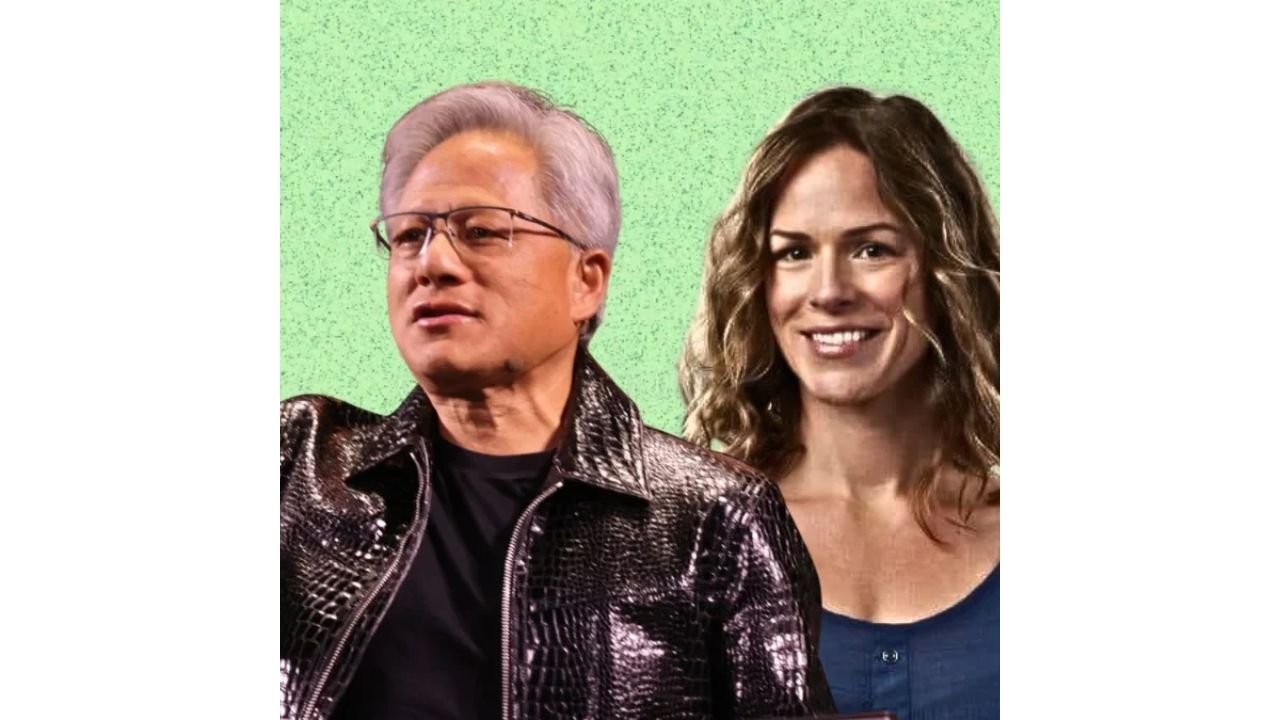
Jensen Huang, Nvidia’s 63-year-old co-founder, and Kimberly Powell, the company’s healthcare executive, became the subject of reported relationship allegations in November 2026. According to the information attributed to The New York Times, the allegations involved a personal relationship between Huang and Powell, who reportedly worked directly under him. The claims emerged amid wider scrutiny of Nvidia’s leadership and corporate governance.
Reports dated November 11 and 12 also described a leadership transition involving Huang and longtime Nvidia finance executive Colette Kress. However, the personal allegations, their underlying evidence and the circumstances of the reported leadership change require careful distinction from independently established facts.
Who Is Kimberly Powell?
Kimberly Powell is a senior Nvidia executive associated with the company’s healthcare and life sciences business.
She joined Nvidia in 2008 and became vice president of healthcare in 2017, according to her published professional background.
Her work focuses on expanding the use of accelerated computing and artificial intelligence in medicine.
That includes technology supporting medical imaging, scientific research, drug discovery and healthcare data analysis.
Powell has represented Nvidia at industry conferences and participated in discussions about how AI could change healthcare.
Her position places her within an important business area as Nvidia expands beyond traditional graphics processing into scientific and enterprise computing.
Who Is Jensen Huang?
Jensen Huang co-founded Nvidia in 1993 and became one of the most influential executives in the semiconductor industry.
Born on February 17, 1963, Huang is 63 years old as of November 2026.
He helped transform Nvidia from a graphics chip manufacturer into a major supplier of processors used for artificial intelligence.
Under his leadership, the company became closely associated with the global expansion of AI infrastructure.
Huang’s public identity has long been tied to Nvidia’s business strategy, product launches and technology conferences.
He is married to Lori Huang, whom he met while studying at Oregon State University.
November 2026 Report
On November 11, 2026, The New York Times was cited as reporting allegations concerning Huang and Powell.
According to the account supplied, five company sources described an alleged romantic relationship between the two executives.
The report also raised questions about workplace reporting relationships and potential conflicts of interest.
Because the allegations concern private conduct, the distinction between reported claims and independently confirmed facts is important.
The existence of allegations does not, by itself, establish every detail of the alleged relationship.
Neither speculation about personal circumstances nor anonymous-source reporting should be presented as a substitute for direct confirmation.
Workplace Questions
One of the central issues raised by the reported allegations was Powell’s professional relationship with Huang.
The supplied account describes Powell as an executive who reported directly to Nvidia’s chief executive.
Personal relationships between senior executives and direct reports can create concerns about workplace fairness, decision-making and potential conflicts of interest.
Companies commonly address these issues through disclosure requirements, internal policies and governance procedures.
However, whether a particular relationship violated a company policy depends on the policy’s actual language and the findings of any relevant investigation.
No independent conclusion about a specific policy violation can be drawn solely from the reported allegations.
Hotel Allegations
The supplied reports also describe an alleged incident during Nvidia’s GTC developer conference in San Jose in March 2026.
According to those accounts, Huang and Powell were reportedly filmed behaving affectionately at a hotel.
Additional claims suggest that a member of Huang’s security team intervened after noticing the recording.
The account further alleges that the person filming was asked to sign a confidentiality agreement.
These details remain reported allegations rather than independently verified findings in this article.
Without access to the original recording, relevant documentation or an official investigation, the precise circumstances cannot be established.
Separate Investigation
The Powell allegations emerged during another controversy involving Huang and Alice Huang, a businesswoman associated with Singapore-based data centre company Megaspeed.
U.S. officials reportedly suspected Alice Huang of having connections to Chinese intelligence.
Those suspicions remain allegations, and Jensen Huang denied knowing that she allegedly worked for the Chinese government.
He had previously acknowledged being unfaithful to his wife, Lori, without initially identifying the other person.
The controversy prompted Nvidia’s board to commission an independent investigation into possible foreign intelligence concerns.
The subsequent Powell report added questions about internal corporate conduct to an already serious situation. <Cite refs={[“turn518335news5″,”turn518335news21”]}/>
Huang’s Resignation
Nvidia announced on November 12, 2026, that Jensen Huang had resigned as president, chief executive officer and board member.
The company’s regulatory filing stated that its board accepted his resignation effective November 11.
The official announcement thanked Huang for his contributions but did not identify the Powell allegations as the sole reason for his departure.
His exit followed several days of controversy involving his personal conduct and reported national security concerns.
The resignation ended more than three decades of leadership at the company he co-founded in 1993. <Cite refs={[“turn518335search11″,”turn518335news3”]}/>
New Nvidia Leadership
Following Huang’s departure, Nvidia appointed Colette Kress as interim chief executive officer.
Kress had served as the company’s chief financial officer since 2013 and was responsible for overseeing its financial operations during a period of extraordinary growth.
She will continue holding the CFO position while leading Nvidia temporarily.
The company also appointed Harvey Jones as board chair and began considering internal and external candidates for a permanent CEO.
The leadership transition comes at a crucial time for Nvidia, whose processors remain central to the global artificial intelligence industry. <Cite refs={[“turn518335search12″,”turn518335news1”]}/>
Powell’s Public Response
As of November 13, 2026, no direct public statement from Kimberly Powell addressing the reported relationship was established in the cited coverage.
Reports also indicated that she was removed from the speaker lineup for the Milken Institute’s Future of Health Summit.
That change attracted attention because Powell had been a visible representative of Nvidia’s healthcare business.
However, removal from a conference programme does not establish wrongdoing or confirm the allegations.
Her employment status and any possible internal disciplinary action should not be assumed without an official announcement.
Latest Developments
The controversy has raised broader questions about corporate governance, executive accountability and leadership continuity at one of the world’s most valuable technology companies.
Huang’s resignation and Kress’s appointment are confirmed corporate developments. The reported relationship with Kimberly Powell remains a separately reported personal allegation.
For Nvidia, the immediate challenge is maintaining business stability while its board searches for a permanent leader.
For Powell, public attention has shifted from her work in healthcare AI to questions surrounding the reported relationship.
As of November 13, 2026, the central distinction remains clear: Nvidia’s leadership transition is documented, while the complete circumstances of the alleged relationship have not been independently established in all their details.