
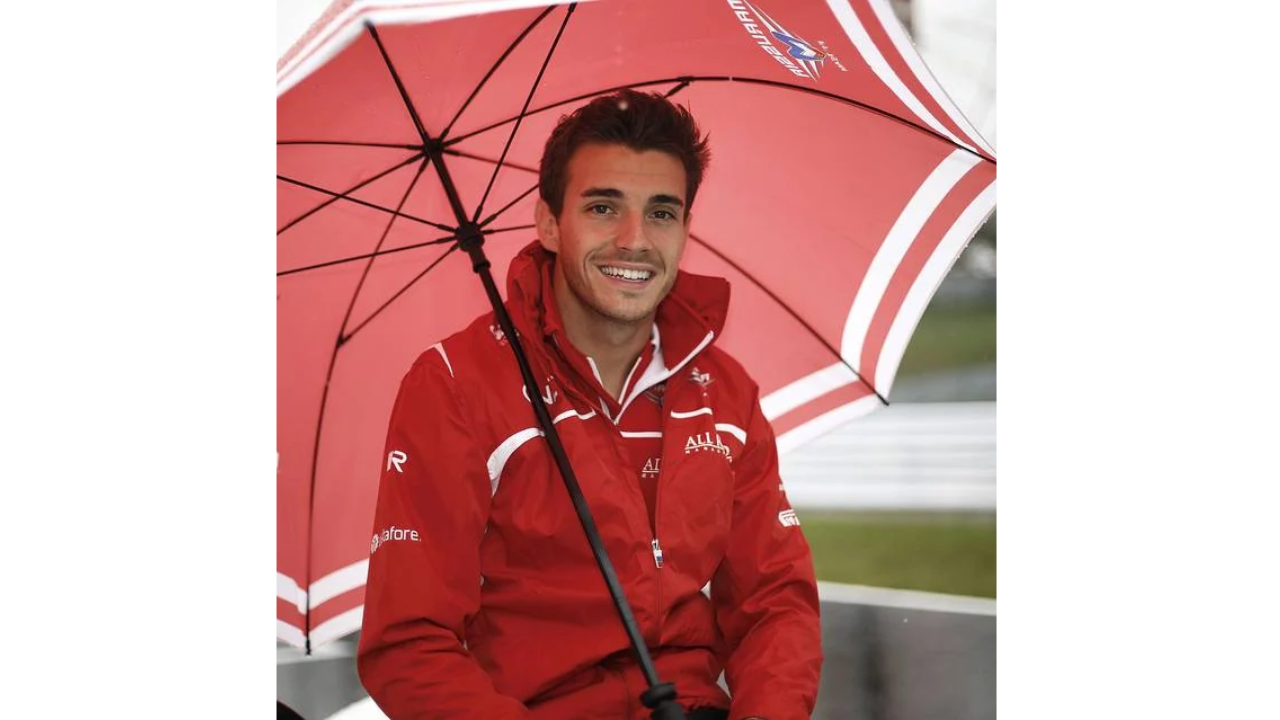
Jules Bianchi suffered a devastating accident during the Japanese Grand Prix on October 5, 2014, when his Marussia Formula 1 car slid off the rain-soaked Suzuka Circuit and struck a heavy recovery vehicle. The French driver sustained a severe brain injury and remained unconscious for more than nine months before dying on July 17, 2015, at the age of 25. His death marked Formula 1’s first driver fatality resulting from a Grand Prix accident since Ayrton Senna in 1994 and became a turning point in the sport’s approach to safety.
What Happened?
The 2014 Japanese Grand Prix took place in extremely wet conditions as Typhoon Phanfone approached Japan.
Heavy rainfall reduced visibility and made parts of the Suzuka Circuit dangerously slippery.
Bianchi was driving for the Marussia F1 Team when he lost control at Turn 7, known as Dunlop Curve.
Earlier, Sauber driver Adrian Sutil had crashed at the same corner, leaving his car stranded in the runoff area.
A recovery vehicle had entered the area to remove Sutil’s damaged car.
On lap 43, Bianchi’s Marussia left the circuit and struck the recovery machinery.
The collision caused catastrophic damage and brought his race to a tragic end.
The Crash
Bianchi’s car collided with a heavy mobile recovery vehicle weighing approximately 6.5 tonnes.
The impact occurred beneath the rear section of the machinery, exposing the driver to enormous forces.
The Marussia’s upper safety structure suffered extensive damage.
Reports from the accident investigation described an exceptionally severe deceleration, with a frequently cited peak figure of approximately 254G.
That figure represents an extreme, momentary force rather than a sustained load.
Emergency personnel immediately recognized the seriousness of the incident.
The race was eventually stopped, and Lewis Hamilton was declared the winner.
However, the result became secondary to concerns about Bianchi’s condition.
His Brain Injury
The collision caused a diffuse axonal injury, one of the most serious forms of traumatic brain injury.
This type of injury involves widespread damage to nerve fibers inside the brain, often caused by violent acceleration or deceleration.
Bianchi lost consciousness following the crash.
Medical teams transported him by ambulance to Mie Prefectural General Medical Center in Japan, where he underwent emergency surgery.
His condition remained critical.
The injury was particularly devastating because it affected extensive areas of the brain rather than a single isolated location.
Despite intensive treatment, Bianchi did not regain consciousness.
When Did He Die?
Jules Bianchi died on July 17, 2015, at the age of 25.
His death came more than nine months after the Japanese Grand Prix accident.
Following his initial treatment in Japan, he had been transferred to a hospital in Nice, France, closer to his family.
He remained in a coma as doctors continued providing medical care.
His family announced his passing after months of uncertainty surrounding his condition.
The news deeply affected Formula 1 teams, drivers, officials, and supporters worldwide.
Bianchi became the first Formula 1 driver to die from injuries sustained during a World Championship race since Ayrton Senna’s fatal accident at Imola in 1994.
Why Did He Crash?
The FIA conducted an extensive investigation into the circumstances surrounding Bianchi’s accident.
Its accident panel identified several contributing factors rather than attributing the tragedy to one isolated cause.
Extremely wet track conditions played a major role.
Standing water at Dunlop Curve reduced available grip, while the racing line had become narrower as drivers attempted to avoid the wettest sections.
Double-waved yellow flags were being displayed because of Sutil’s earlier accident.
The panel concluded that Bianchi had not reduced his speed sufficiently to maintain control in those conditions.
The presence of heavy recovery machinery in the runoff area also made the consequences of leaving the circuit exceptionally severe.
Braking Problems
The investigation examined Bianchi’s actions immediately before the collision.
Data indicated that he pressed the accelerator and brake pedals simultaneously.
The FIA found that the Marussia’s brake-by-wire system did not respond as intended to the simultaneous pedal inputs.
An incompatibility involving the system’s fail-safe arrangements prevented the expected engine-torque reduction.
The front wheels subsequently locked, affecting the car’s ability to slow and change direction.
However, the investigation did not conclude that this technical issue alone caused the accident.
The collision resulted from a combination of conditions, driver inputs, vehicle behavior, and the presence of recovery equipment.
FIA Investigation
Following the tragedy, the FIA appointed a 10-member accident panel to examine the incident and recommend improvements.
The investigation considered circuit conditions, warning signals, vehicle data, recovery procedures, and driver safety.
One major concern was how to ensure drivers slowed sufficiently when marshals were working near the track.
Traditional yellow flags relied heavily on individual drivers interpreting the danger and adjusting their speed.
The panel recommended stronger speed-control procedures during hazardous situations.
Its findings influenced subsequent changes to race management and safety protocols.
The investigation also highlighted the importance of reviewing technical systems that could behave unexpectedly during emergencies.
Virtual Safety Car
One of the most important developments following Bianchi’s accident was the introduction of the Virtual Safety Car system in Formula 1 in 2015.
The VSC requires drivers to reduce their speed and remain above a specified minimum time through monitored sections of the circuit.
Unlike a conventional safety car, it does not require the field to gather behind a physical vehicle.
The system allows race control to impose more consistent speed reductions during certain incidents.
It is particularly useful when marshals need to recover vehicles or address hazards without stopping the race entirely.
The change represented a significant improvement over relying exclusively on warning flags.
The Halo Device
Bianchi’s accident also intensified discussions about protecting drivers from impacts involving objects above the cockpit.
Formula 1 had already been researching additional cockpit protection before the tragedy.
However, the crash added urgency to those efforts.
The Halo became mandatory on Formula 1 cars in 2018, providing a reinforced structure around the driver’s head.
The device is designed to deflect or withstand certain impacts involving other cars, barriers, and debris.
It cannot guarantee survival in every type of accident, particularly a collision involving heavy machinery.
Nevertheless, its introduction became part of a broader period of safety development shaped by serious racing incidents, including Bianchi’s crash.
His Racing Legacy
Born on August 3, 1989, in Nice, France, Jules Bianchi was considered one of the most promising young drivers of his generation.
He joined Formula 1 with Marussia in 2013 after progressing through junior racing categories.
His standout achievement came at the 2014 Monaco Grand Prix, where he finished ninth, earning Marussia its first World Championship points.
Bianchi was also part of Ferrari’s young driver development program and was widely regarded as having considerable potential.
His death ended a career that many believed could have reached the sport’s highest level.
His legacy remains closely connected to the safety improvements introduced after Suzuka.
Latest Update
As of November 2026, Jules Bianchi’s fatal accident remains one of the most consequential tragedies in modern Formula 1 history.
The October 2014 collision at Suzuka exposed serious risks involving wet-weather racing, speed management, and trackside recovery vehicles.
The subsequent investigation contributed to changes in safety procedures, particularly the introduction of the Virtual Safety Car.
More than eleven years after his death, Bianchi is remembered for his talent, his achievements with Marussia, and the lasting influence of the tragedy on motorsport safety.
His accident remains a reminder that driver protection depends on continuous improvements in technology, race control, and emergency procedures.